Is a narwhal tusk a tooth? What it's made of and why it twists
A narwhal tusk is a tooth, not a horn. What it's made of, why it spirals, what it's for and how long it gets, from the study and NOAA.

Key points
- A narwhal's tusk is a tooth, usually the male's upper left canine, made of dentine wrapped in a layer of cementum.
- A study in Nature Communications found its collagen fibers form two spirals that turn in opposite directions.
- Scientists still don't know for sure what the tusk is for, though the evidence points to mate selection and social contact.
A narwhal's tusk is not a horn. It is a tooth, usually the male's upper left canine, which pushes out through the upper lip, twists to the left and can pass 2 meters (6.6 feet). A study in Nature Communications has now shown what sits behind that spiral: two microscopic helices that twist in opposite directions, one inside the other.
The paper came out on August 18, and the Paul Scherrer Institute's release on it was picked up again this week. Is the tusk a tooth, what is it made of, and why does it spiral? Here is what the researchers and NOAA Fisheries say.
Is a narwhal tusk a tooth or a horn?
A tooth. Narwhals are toothed whales with two teeth in the upper jaw, according to the study. In males, the left canine grows into the tusk, while the right tooth stays embedded in the skull. In females, both teeth usually stay in the skull.
There are exceptions. The researchers note rare cases of females with tusks, males without one, and animals with two tusks. Even when the right tooth also grows out, it still twists in a left-handed helix.
NOAA Fisheries says the left tooth normally starts to grow out when a male is two or three years old.
What is a narwhal tusk made of?
Mostly dentine, the tissue that also makes up the inside of our own teeth, with an outer coat of cementum and a pulp chamber running down the middle. The odd part is the cementum. In other mammals it sits only at the root of a tooth, where the tooth meets the bone. In a narwhal it runs from the root all the way to the tip.
Both layers are built from collagen fibrils mineralized with tiny hydroxyapatite crystals, building blocks similar to those in bone, according to the paper. PSI compares the result to reinforced concrete: the collagen fibers act as internal reinforcement, like a steel frame, and the mineral crystals give hardness. "The narwhal tusk, too, must be both hard and flexible," said Marianne Liebi, a PSI researcher and co-author of the study. "Only then can it withstand the strong hydrodynamic forces that swimming generates."
Why does a narwhal tusk spiral?
That is the question the study set out to answer. An international team, including PSI scientists and working within a NordForsk project led by Henrik Birkedal of Aarhus University in Denmark, scanned tusk samples at three European synchrotrons: the Swiss Light Source at PSI, MAX IV in Lund, Sweden, and the ESRF in Grenoble, France. They used a method called tensor tomography, which turns the way X-rays scatter off ordered structures into a 3D map of how nanometer-scale fibers point.
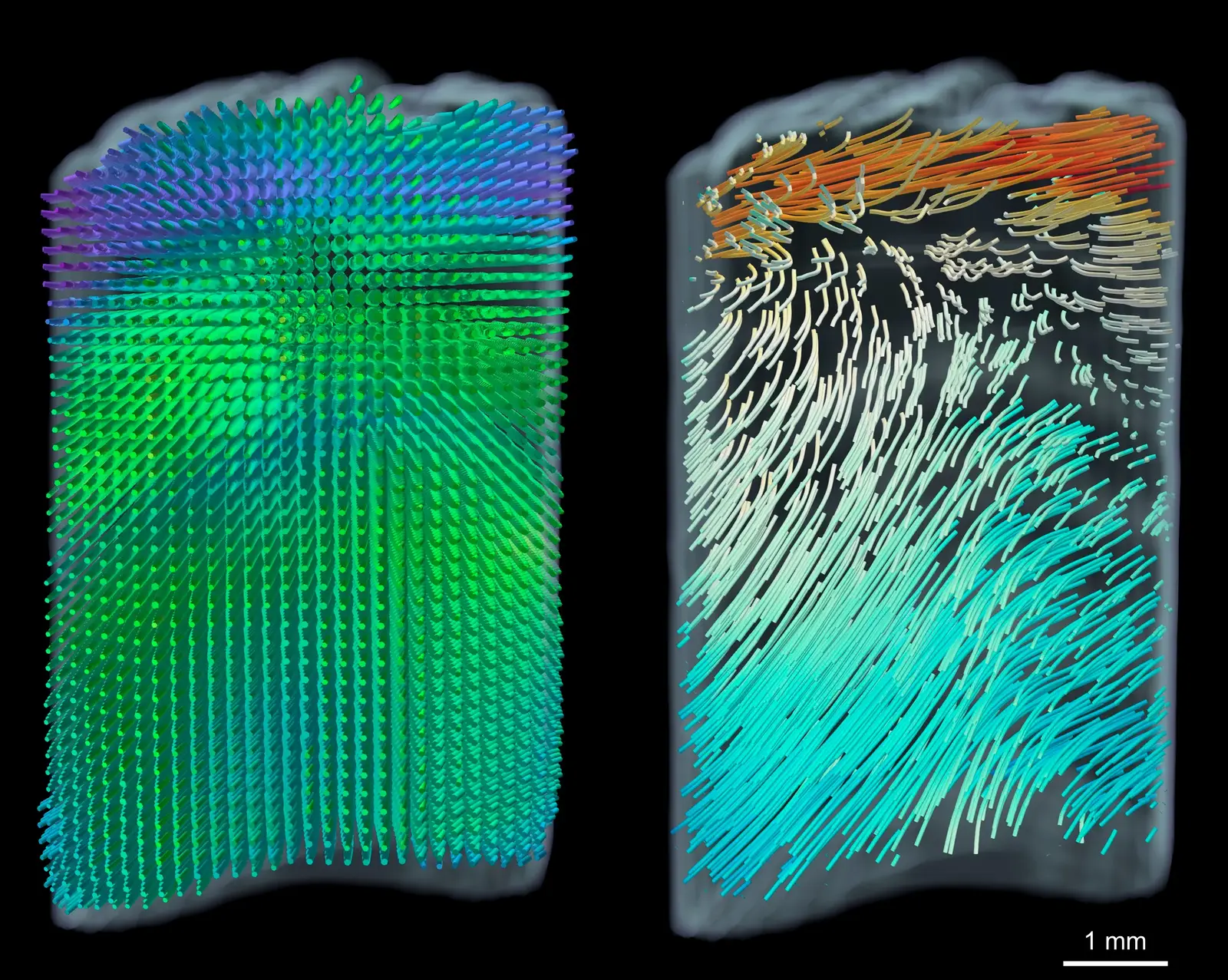
At first the scans showed only a regular pattern. The helix appeared once the researchers compared how neighboring points were oriented and connected them. "All we had to do then was connect the dots – as in a children's paint-by-numbers kit – and suddenly the structure became visible: two intertwined spirals," said first author Adrian Rodriguez-Palomo.
The result, in the paper's words: the cementum "has a left-hand helix of collagen fibrils, while dentine contains a right-hand arrangement." The summary on the paper's page says this double helix with opposite twists "creates a straight, mechanically stable tusk." PSI compares it to the twisted fibers of a rope, which resist torsion.
The tusk also carries a lot of locked-in stress. When researchers cut tusks in half lengthwise, the halves twisted by more than 180 degrees from base to tip, and by more than 200 degrees in the longest tusks. In bending tests, rods cut along the tusk were stiffer than rods cut across it, with a mean elastic modulus of 17.6 GPa against 10.8 GPa.
What is the narwhal tusk used for?
Nobody knows for certain. The study calls the tusk's function "a subject of speculation," but notes that tusk length varies far more than other body measurements, which strongly suggests it is a sexual trait. Males and females show no difference in swimming ability or survival, even though females usually have no tusk. Narwhals have also been seen using their tusks in play-like behavior.
NOAA Fisheries says the tusk's main role is as a secondary sex characteristic, letting males size each other up without fighting and possibly helping females choose mates. It adds that the tusk may also work as a sensory tool for detecting changes in the environment, and for catching prey.
How long and how old can a narwhal tusk get?
The study says tusks can exceed 2 meters, and NOAA Fisheries says a tusk may grow up to 9.8 feet long and weigh more than 20 pounds. The tusk keeps growing for the animal's whole life. PSI says a tusk can easily reach 70 years of age.
Sources differ on how long narwhals live. NOAA's species page says up to 50 years, while the study's authors cite lifespans of more than 80 years.
Those decades leave a record. The dentine holds annual growth layers, a little like tree rings, and the wider NordForsk project behind the study is using them to read past Arctic climate and food availability.
What we still don't know
The study explains how the spiral is built from its smallest parts. The authors write that "the formation of such a structure remains unknown," because too little is known about how narwhal tusks grow and develop. And the tusk's main job is still unsettled. The wider NordForsk project is also studying how the tusk's growth relates to environmental and climate conditions, according to PSI.
FAQ
Do female narwhals have tusks?
Usually not. Both of a female's teeth normally stay inside the skull, but NOAA Fisheries and the study both note that tusked females have been recorded.
Is a narwhal tusk a bone?
No. It is a tooth made of dentine and cementum, though the study notes its building blocks, mineralized collagen, are similar to those found in bone.
Which way does a narwhal tusk spiral?
Counter-clockwise, or left-handed, according to NOAA Fisheries and the study. Inside, the cementum's fibers twist left and the dentine's twist right.
Are narwhals protected?
Yes. NOAA Fisheries says narwhals are protected throughout their range under the US Marine Mammal Protection Act, and the species is listed in Appendix II of CITES, the treaty on trade in endangered species. NOAA Fisheries lists climate change, hunting and loss of sea ice among the threats to narwhals.
Sources
- Nature Communications: The narwhal tusk assembles its macroscopic helix from building blocks with opposing twists (Rodriguez-Palomo et al.), published August 18, 2026
- Paul Scherrer Institute: How the "unicorn of the seas" got its helix, published August 18, 2026
- NOAA Fisheries: Narwhal species profile, last updated September 1, 2026
This story was reported and drafted with AI tools from the sources linked above, fact-checked, and edited by Parth Garg. How we use AI.
Related on pblcty