Why is Europa Clipper flying past Earth on December 3?
NASA's Europa Clipper flies past Earth on December 3 for a gravity assist toward Jupiter. When it's closest, who can see it and when it reaches Jupiter.
Key points
- NASA's Europa Clipper passes about 3,140 to 3,450 kilometers from Earth on December 3, closest at 3:14 p.m. EST (20:14 UTC).
- The flyby is a gravity assist that saves propellant and sends the spacecraft on to Jupiter, where it is due to start orbiting in April 2030.
- People near the flight path, notably in southern Europe and Africa, may spot it with relatively large hobby telescopes.
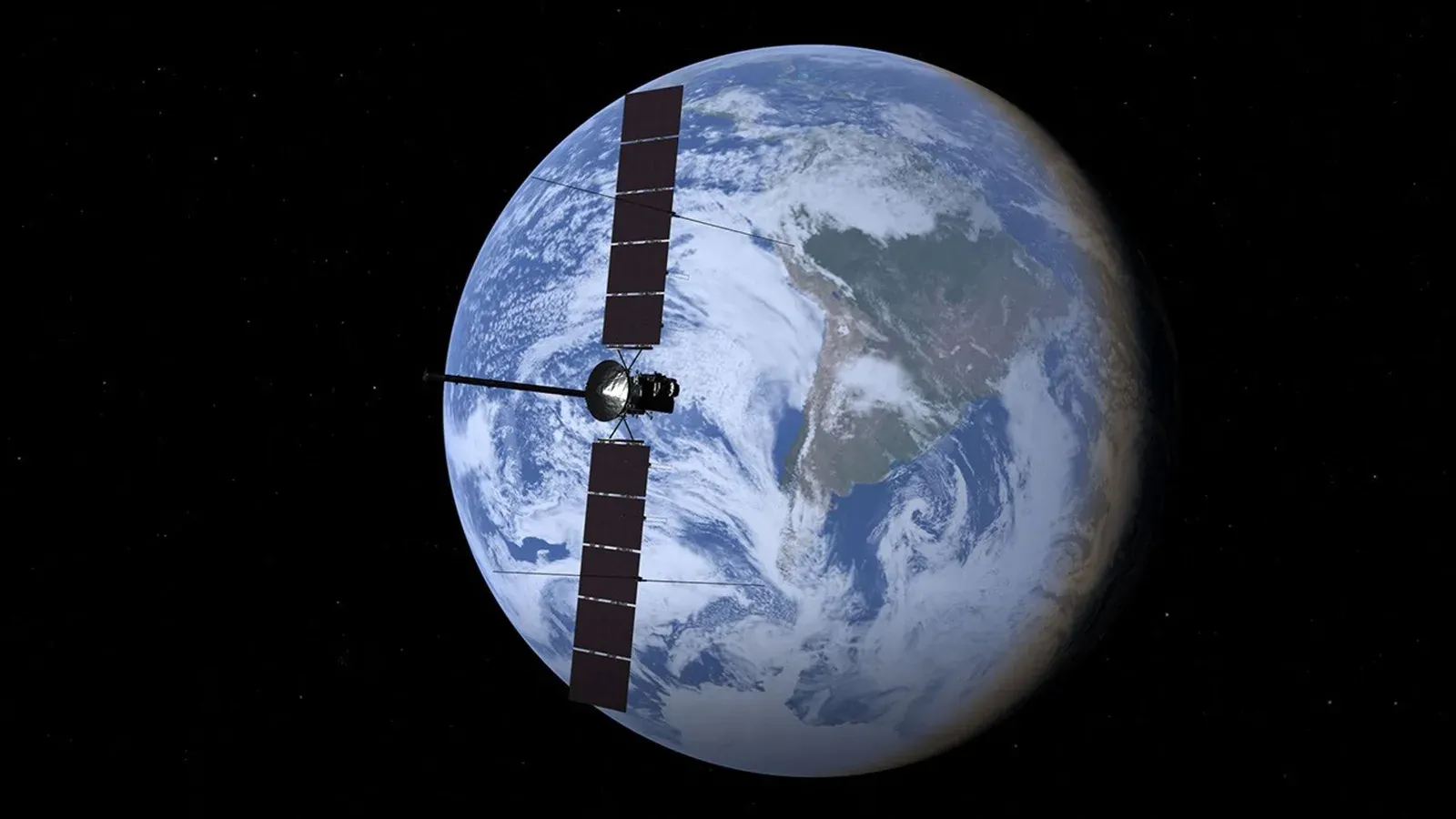
NASA's Europa Clipper is swinging past Earth on December 3 to borrow speed from the planet's gravity, which NASA calls a propellant-saving boost for its trip to Jupiter. NASA puts the closest distance at about 1,950 to 2,133 miles (3,140 to 3,450 kilometers). Closest approach, west of Africa, comes at 3:14 p.m. EST (20:14 UTC, or 1:44 a.m. IST on December 4).
That timing and distance come from NASA's preview of the Earth flyby, published on November 25. The spacecraft is not coming home: after this pass it heads off on what NASA calls "a yearslong beeline for Jupiter," and it is scheduled to begin orbiting the gas giant in April 2030.
Why does Europa Clipper need to fly past Earth?
A gravity assist uses a planet's orbital momentum to change a spacecraft's speed and direction. Europa Clipper weighs about 6,000 kilograms (12,800 pounds) and, by NASA's count, is the largest spacecraft the agency has launched into deep space.
"We're coming down into the gravity well of Earth, following its curve, and shooting out again," said Robert Pappalardo, the mission's project scientist at NASA's Jet Propulsion Laboratory (JPL). "The spacecraft is able to get pulled by the gravity of the planet and continue on its way — now with a slightly changed trajectory and moving faster than it was before."
It has done this once already. In March 2025, Europa Clipper passed 884 kilometers (550 miles) above the surface of Mars, using the planet's pull to slow down and reshape its orbit around the Sun. The Earth pass works the other way: NASA says the aim is to gain speed and alter the trajectory a bit more.
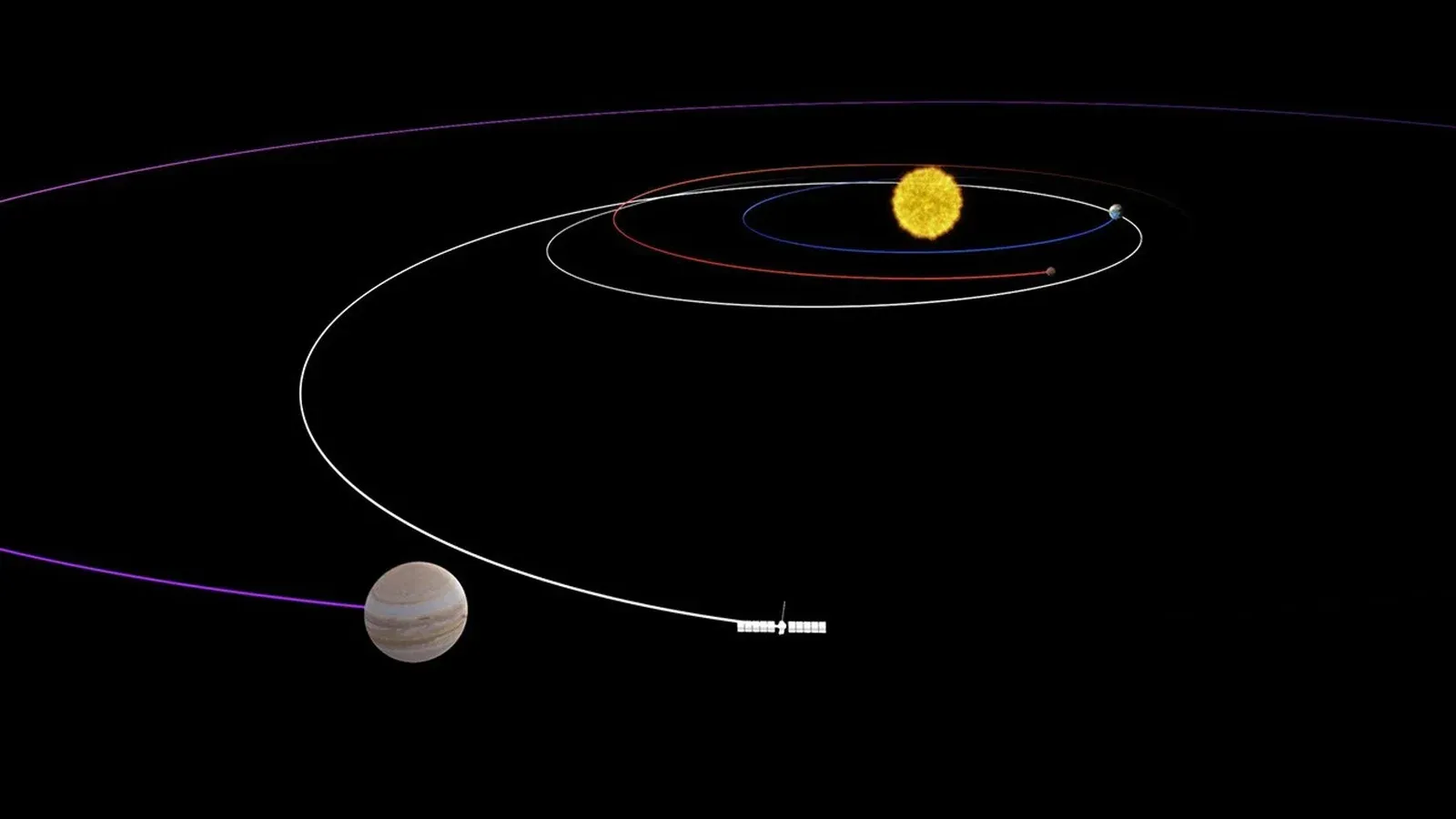
Launch on a SpaceX Falcon Heavy from Kennedy Space Center in Florida.
Mars flyby, 884 km (550 miles) above the surface.
Earth flyby, about 3,140 to 3,450 km from Earth, closest at 3:14 p.m. EST.
- Planned April 2030
Starts orbiting Jupiter, then makes 49 close flybys of Europa.
Can you see Europa Clipper from Earth during the flyby?
Possibly, with the right equipment and location. NASA says the spacecraft "will even be observable with relatively large hobby telescopes for those near the closest approach trajectory, notably in southern Europe and in Africa." NASA mentions telescopes, not the naked eye, and its preview gives no sky chart or brightness figure for the pass.
For everyone else, NASA's Eyes on the Solar System tool, linked from the mission page, shows where Europa Clipper is in real time and can jump ahead to December 3 to preview the pass. December has an easier target for anyone without a large telescope: NASA says November's supermoon was the first of three in a row, and our guide to the next supermoon has the date.
What will Europa Clipper do during the Earth flyby?
Navigators are using the flyby to save propellant, and scientists are using it as a rehearsal. Europa Clipper will run all nine of its science instruments through the pass, and teams will compare what they record with existing Earth data to fine-tune them.
- Magnetometer. At Jupiter it will measure how the planet's magnetic field interacts with Europa, a measurement the team hopes will confirm the ocean believed to lie under the ice. "The flyby will enable us to calibrate the instrument absolutely, using its observations at Earth to refine other calibrations done before launch and in flight," Pappalardo said.
- E-THEMIS thermal imager. On the way in, it will look at Earth once every eight hours. At Mars it captured the planet in infrared; at Europa it will track warm regions to find where water is closest to the surface.
- Europa-UVS ultraviolet spectrograph. Its Earth readings will be compared with those from NASA's Lunar Reconnaissance Orbiter, which will point its LAMP instrument at Earth's geocorona, the outermost part of the atmosphere, during the flyby.
"We're practicing the intricacies of the operation, but we're also practicing how to work together to produce the best science," said Erin Leonard, the mission's project staff scientist at JPL.
When does Europa Clipper reach Jupiter and Europa?
Europa Clipper launched on October 14, 2024, on a 2.9-billion-kilometer (1.8-billion-mile) journey and is due to begin orbiting Jupiter in April 2030. As it closes in, it will use the gravity of Ganymede, another of Jupiter's moons, to slow down and be captured by Jupiter. NASA's mission page lists Europa as the target with arrival in 2030, but gives no date for the first close pass.
From orbit it will make 49 close flybys of Europa, with every science instrument running on every pass. The targets are the thickness of the moon's icy shell, its composition and its geology. NASA's main question is whether there are places below Europa's surface that could support life, and scientists think the ocean there may hold more than twice as much liquid water as all of Earth's oceans combined.
Europa Clipper FAQ
Will Europa Clipper return to Earth?
Not in NASA's published plan. The December 3 pass is the gravity assist that sends the spacecraft on to Jupiter, where its orbit is planned to begin in April 2030.
Does Europa Clipper have a lander?
No. NASA lists it as an orbiter and flyby mission: it will orbit Jupiter and study Europa during 49 close passes rather than touching down.
Will Europa Clipper take pictures of Earth?
Its instruments will collect data on Earth, and the team says it wants to share what it sees. "This is Earth, and everyone understands what that data means," Leonard said. NASA has not said which images it will release, or when.
How big is Europa Clipper?
Its solar arrays stretch more than 30 meters (100 feet) tip to tip, roughly a basketball court's length, according to NASA, which calls it the largest spacecraft it has built for a planetary mission.
When did Europa Clipper launch?
It lifted off at 12:06 p.m. EDT on October 14, 2024, on a SpaceX Falcon Heavy from Launch Complex 39A at NASA's Kennedy Space Center in Florida.
Sources
- NASA Science: NASA's Europa Clipper Zooming by Earth on Way to Jupiter's Icy Moon, published November 25, 2026, updated November 27, 2026
- NASA Science: Europa Clipper mission page, updated November 25, 2026
- NASA Science: What's Up, November 2026 Skywatching Tips from NASA, published November 2, 2026
This story was reported and drafted with AI tools from the sources linked above and checked against them by a separate AI fact-checker. It was published automatically under rules set by editor Parth Garg. How we use AI.
Related on pblcty