How big is the DART crater on asteroid Dimorphos?
ESA's Hera spacecraft found a stadium-sized crater spanning Dimorphos, the asteroid NASA's DART hit in 2022. What the new images show and what's next.
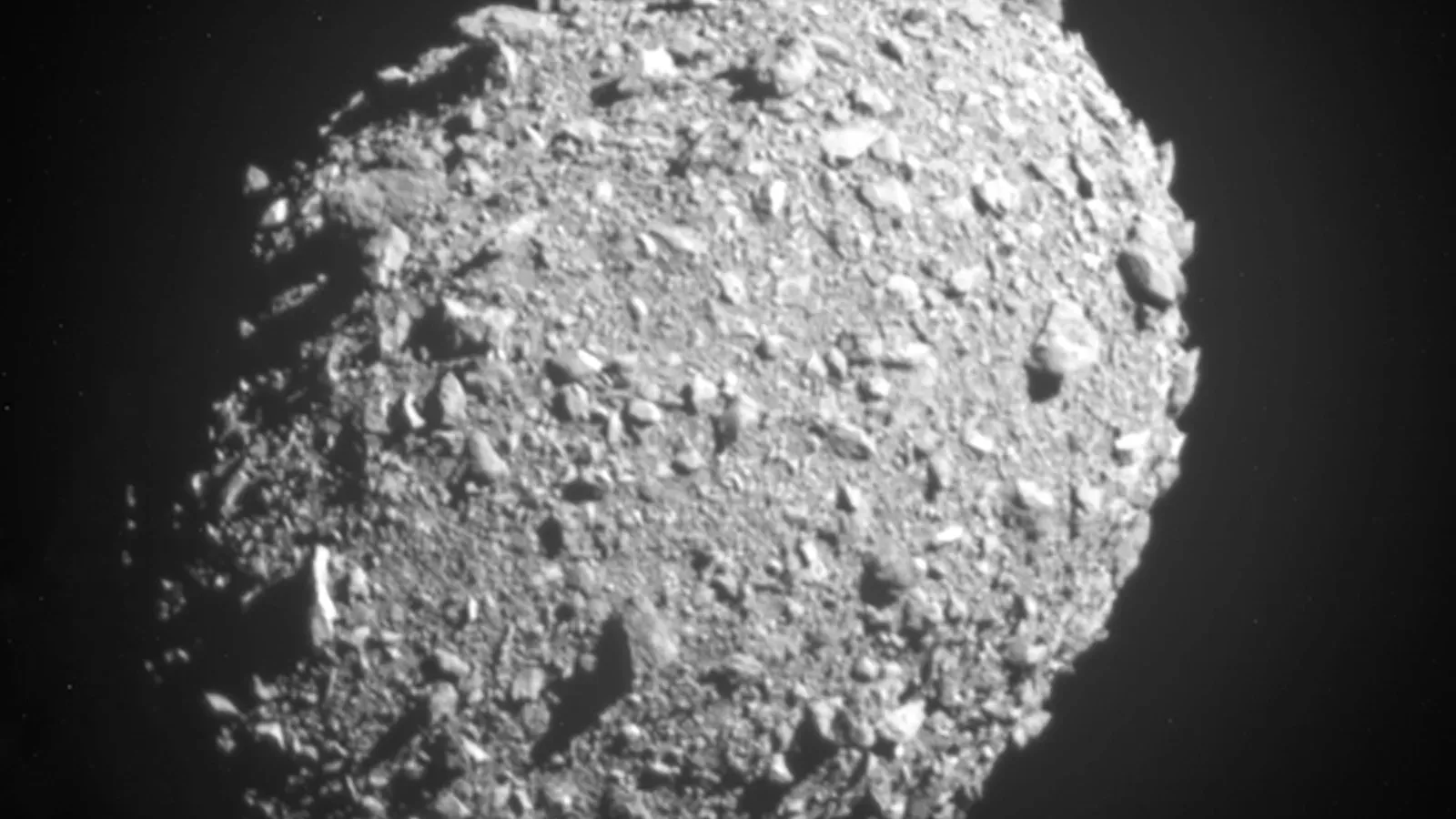
The crater NASA's DART spacecraft punched into the asteroid moonlet Dimorphos is about the size of a sports stadium, and it stretches across the asteroid's entire width. That is the first answer from the European Space Agency's Hera spacecraft, which released its first close look at the impact site on November 25, a little over three years after the collision.
The images settle a question planetary scientists had debated since 2022: what did the world's first asteroid deflection test actually do to the asteroid? According to ESA, the answer is a flattened face, a moonlet that now tumbles, and a cloud of boulders nobody had seen before.
How big is the DART crater?
ESA describes the struck side of Dimorphos as "flattened into an impact crater the size of a sports stadium, which extends across the asteroid's entire width." Hera's Asteroid Framing Camera shows that flattened face on one side of the moonlet.
For scale, ESA gives Dimorphos a diameter of 151 metres. So a crater that spans the whole asteroid is, at most, roughly that wide. ESA has not yet published a precise crater diameter or depth in metres. Hera is still about 25 to 30 km from the asteroids. ESA says its approach in December will bring higher-resolution images.
NASA's own DART pages list slightly larger sizes for the pair (about 160 metres for Dimorphos and 780 metres for Didymos), so expect small differences between figures quoted by the two agencies.
What was DART, and why did it hit an asteroid?
NASA's Double Asteroid Redirection Test, built and managed by the Johns Hopkins Applied Physics Laboratory, was the first test of whether a spacecraft could change an asteroid's path by ramming it. The 570-kilogram spacecraft hit Dimorphos on September 26, 2022, at roughly 22,530 km per hour.
Dimorphos is a moonlet that orbits a bigger asteroid, Didymos (730 metres across, by ESA's figure). Neither poses any threat to Earth, NASA says, before or after the test. That made the pair a safe target: scientists could measure the change in the small one's orbit around the big one from telescopes on Earth.
It worked better than expected. ESA says the impact shortened Dimorphos's orbit by "a much greater than predicted 33 minutes." NASA's figure, from the weeks after impact, is 32 minutes, from 11 hours 55 minutes to 11 hours 23 minutes. NASA credits much of that extra push to the debris blasted off the surface, which worked the way escaping air pushes a balloon.
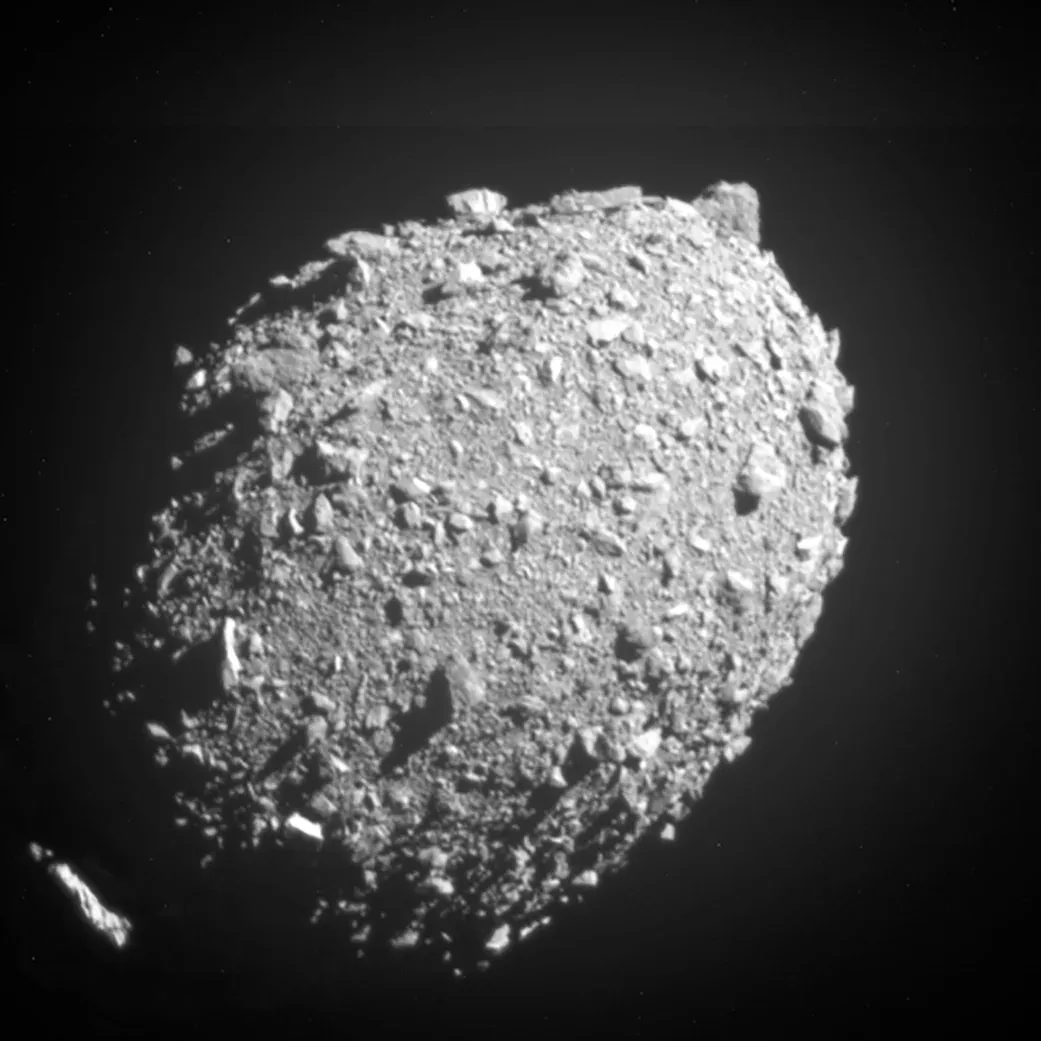
That is what Dimorphos looked like 11 seconds before the collision, in the last DART image that shows the whole moonlet. NASA says it was taken from 68 km away. Hera's new images show the same rock after the impact.
What else did Hera find on Dimorphos?
Before Hera arrived, scientists disagreed on whether DART had left a crater, reshaped the asteroid, or left it unchanged. Hera principal investigator Patrick Michel, director of research at CNRS and the Observatoire de la Côte d'Azur, told ESA: "Much to our surprise the answer turns out to be all three at once!"
Three findings stand out:
- A tumbling moonlet. ESA's Hera mission scientist Michael Kueppers says "the DART impact has left Dimorphos tumbling wildly in its orbit." Apart from the crater, ESA says, the rest of Dimorphos shows no evidence of major changes.
- Hundreds of boulders. The pair is "surrounded by hundreds of orbiting boulders, just a few metres in size," which had not been seen before. ESA says the team will need to account for them as Hera moves in.
- Heat and color data. Besides the framing camera, Hera carries the Hyperscout H multispectral imager and JAXA's Thermal Infrared Imager, TIRI, which measures surface temperatures.
Where is Hera now, and what happens next?
ESA says Hera is flying about 25 to 30 km from Didymos and Dimorphos, at an average speed of just 12 cm per second relative to them. The pair is currently 193.5 million km from Earth.
The next steps, per ESA:
- December 2026: Hera is scheduled to move in to around 13 km from the asteroid pair.
- January 2027: Hera plans to release two shoebox-sized CubeSats to fly closer still. ESA's Hera material describes the Luxembourg-led Juventas, which will use low-frequency radar to probe an asteroid's interior, and the Italian-led Milani, which will study surface material and dust.
Why does this matter for planetary defense?
DART proved a spacecraft can nudge an asteroid. Hera is meant to show not only that the technique works, ESA says, but why, so the method could be relied on against a real threat. NASA notes that more research is needed to know whether a kinetic impactor works as well on a solid asteroid as on a loose "rubble pile" like Dimorphos.
The next test of that knowledge is already planned. ESA, with JAXA, is developing Ramses, a mission to the asteroid Apophis, which will fly past Earth on April 13, 2029. You can follow smaller visitors on our tracker of asteroids passing close to Earth.
FAQ
Did DART make a crater on Dimorphos?
Yes. ESA's Hera images show a crater the size of a sports stadium that extends across the asteroid's entire width.
How big is Dimorphos?
ESA gives a diameter of 151 metres. NASA's DART pages list about 160 metres.
How much did DART change the asteroid's orbit?
ESA puts it at 33 minutes, much more than predicted. NASA's figure is 32 minutes, from 11 hours 55 minutes to 11 hours 23 minutes.
Is Dimorphos dangerous to Earth?
No. NASA says neither Didymos nor Dimorphos poses an impact threat to Earth, before or after the DART test.
When will Hera get closer?
ESA plans to bring Hera to about 13 km from the pair in December 2026 and to release its two CubeSats in January 2027.
Sources
- ESA: Hera reveals stadium-sized asteroid crater from spacecraft impact, published November 25, 2026
- ESA: Hera media kit, published November 24, 2026
- NASA Science: Double Asteroid Redirection Test (DART)
- NASA: DART's final images prior to impact, published September 27, 2022
This story was reported and drafted with AI tools from the sources linked above and checked against them by a separate AI fact-checker. It was published automatically under rules set by editor Parth Garg. How we use AI.
Related on pblcty